Most leaders say they want a capable team. Then they spend their week doing the exact things that stop one from forming.
It happens through speed rather than ego. It’s quicker to answer the question than to ask one back. Quicker to fix the slide than explain what’s wrong with it. Quicker to take over the client call than sit through a wobbly version of it. Every one of those choices makes sense in the moment. Stack them up over a year and you’ve trained a team to wait for you.
Capability doesn’t grow when the leader is the shortcut.
Why Capability Comes After Direction
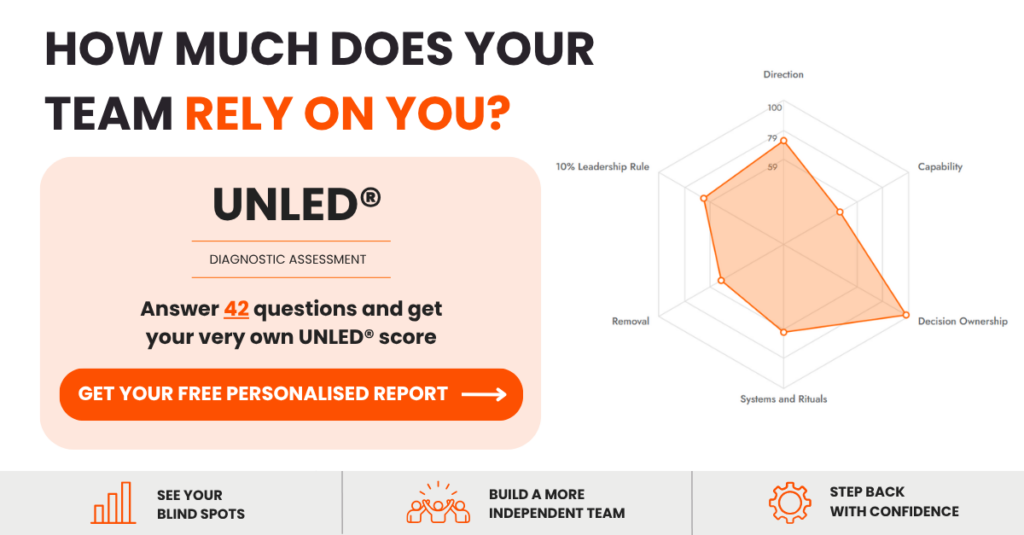
Capability is one of the four pillars in the UNLED® model, alongside Direction, Decision Ownership, and Systems & Rituals. All four hold up Removal, the point where your team keeps performing whether you’re there or not.
It sits behind Direction for a simple reason. Building skill without clarity gives you a team that moves quickly in the wrong direction. Once people know what they’re aiming at, the next question is whether they can get there without you walking beside them.
Capability is also wider than most leaders think. It covers skill, judgement, confidence, and decision quality when things get uncomfortable. It’s knowing what to do when the script runs out. You can have well-trained people who are still completely dependent, and people six months into a role who back themselves and get on with it. Time served has very little to do with it. Exposure and conversations have almost everything to do with it.
The Two Layers of Capability
Capability sits on two layers, and if either one is weak the whole thing wobbles.
Skill
Can they actually do the work? This is the visible layer, and the one most leaders are comfortable with, because skill gaps are measurable and there’s usually a training solution nearby.
The mistake is diagnosing a skill gap as an attitude problem. Someone who hesitates, delays, or asks the same question repeatedly is often just missing experience. Treat that as a motivation issue and you’ll spend months solving the wrong thing, either doing too much for them or leaving them to struggle with something they were never equipped for.
Where skill is genuinely the gap, build scaffolding rather than a crutch. Pair them with someone more experienced for a short stretch. Get them focused training on the specific gap instead of a generic course. Ask them to talk you through their approach before you offer yours, so you hear the thinking rather than just correcting the output.
Will
Do they feel safe enough to use the skill they’ve got? Plenty of capable people hold back, and it’s rarely about ability.
Motivation dies quietly when people feel watched, second-guessed, or corrected for colouring outside the lines. If your culture rewards being right over making progress, or staying quiet over speaking up, people sit back and wait to be told.
One of my managers said something that stuck with me. She told me she didn’t start taking ownership until she knew she wouldn’t get punished for doing things differently. She’d come from somewhere that punished exactly that, so her default was to assume it would happen again. She held back, second-guessed herself, and waited for someone to tell her she’d got it wrong. Once she worked out it wasn’t like that with us, she changed completely. Started backing herself, sharing ideas, taking things on without being asked.
If people are hesitating, the useful question isn’t why they aren’t motivated. It’s what they think they’re protecting themselves from.
How to Spot Which Layer Is Missing
The two layers fail differently, and what you’re seeing tells you which one to work on.
A skill gap looks like work that comes back wrong, questions about how rather than whether, and the same mistakes repeating. A will gap looks like work that comes back safely. Correct, unambitious, and checked with you three times on the way. Capable people producing careful, unremarkable output are usually telling you something about the environment rather than their ability.
How to Build Capability Without Taking Over
The shift is from being hands-on to being minds-on. Your job becomes strengthening how people think rather than improving what they’ve produced.
Coach Forwards, Not Backwards
Most feedback looks in the rearview mirror. What happened, what went wrong, what needs fixing. It’s useful information delivered at the worst possible angle, because the moment someone hears “can I give you some feedback?” they brace for a telling off.
Forward coaching points at the next attempt instead. “What’s your next move here?” “What would you do differently if you ran this again tomorrow?” Nobody can change what already happened, so the conversation stops being a judgement and becomes a plan.
One phrase worth adopting. Instead of asking to give feedback, try “can I offer something that might help next time?” It gives people a choice and makes the intent obvious.
Be Specific Rather Than Encouraging
“Good job” feels nice and teaches nothing. Specific feedback builds something repeatable.
“The way you structured that client summary made the decision easy” tells someone what to keep doing. “Next time, lead with the risk rather than the background” tells them what to adjust. Both take about as long to say as the version that teaches nothing.
Stretch People With a Safety Net Underneath
People grow under pressure, as long as the pressure doesn’t flatten them. A good stretch is bigger than someone’s comfort zone, visible enough that the stakes feel real, and survivable if it goes sideways.
The failure modes sit at both ends. Challenges with no support creates anxiety. Support with no real challenge lets people coast.
Set it up properly when you hand it over. Say out loud that it’s a stretch and you don’t expect it to be perfect the first time. Say you’re around and that you won’t be hovering. Tell them why you picked them, because people grow faster when they feel chosen for something rather than lumbered with it.
Make “What Would You Do?” Your Default
Every time someone brings you a problem, you’re at a decision point. The instinct is to give an answer. The better move is usually to ask a question.
Even when they say they don’t know, don’t let it end there. “Let’s say I’m not around, what’s your gut telling you?” “What’s the smallest first step you could take?”
This does something for you as well. It shows you how people process problems, whether they jump to solutions, spiral into worst cases, or freeze trying to make it perfect. Those patterns are your real coaching material, and you can’t see any of them if you keep answering first.
Why It Feels Slower Before It Feels Better
The early phase feels slower, and that’s where most leaders quit. Of course it feels slower. You’re growing people rather than closing tasks, and those two things move at different speeds. Once it compounds, decisions get made lower down, quality stops swinging, and people arrive with a recommendation instead of a question.
If you keep getting dragged back into the same kinds of problems, the useful question isn’t who keeps bringing them to you. It’s what capability is missing, and what you’re actively doing about it.
Build more thinkers than followers, and you stop being needed in the small stuff.