If a team only performs well when the leader is watching, reminding and pushing, what you’ve got is a leader-powered team. It works. It doesn’t scale, and it doesn’t free you.
Most leaders underestimate how much of their week exists because there’s no system, only supervision. You clarify priorities in passing. You remind people about deadlines. You answer questions you’ve already answered twice. You connect two bits of work because nobody else can see both. All of it feels like leadership, and in the short term it helps. Over time it builds a setup where nothing quite works unless you’re there.
Where Systems and Rituals Sit
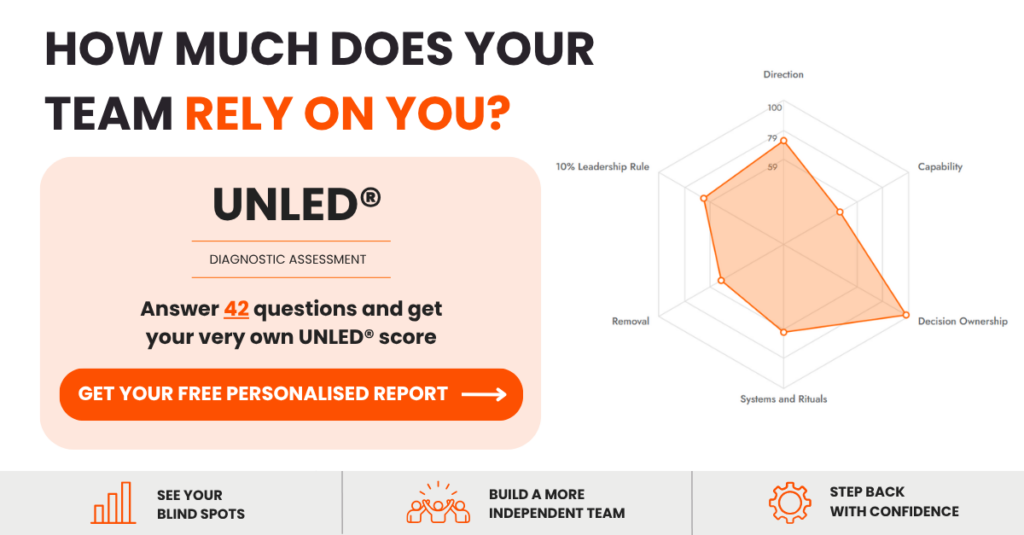
Systems & Rituals is one of the four pillars in the UNLED® model, alongside Direction, Capability, and Decision Ownership. All four hold up Removal, the point where your team keeps performing whether you’re there or not.
This is the pillar that creates stability. Direction, capability and decision rights can all be in good shape and a team will still drift back to you if there’s no structure holding the work together. Systems and rituals carry standards forward when you’re not in the room, which is what makes stepping back safe rather than reckless.
A friend of mine runs a customer excellence team of about fifteen people at a software company. Onboarding, support, renewals. She was the only person who understood how any of it fitted together. The onboarding sequence lived in her head. Escalations depended on her being available to decide who picked them up. New starters learned by sitting next to her for a week, because nothing was written down.
She took two weeks off. Three accounts nearly churned in the first week, and two of her team told her afterwards they’d spent most of the fortnight working out what they were supposed to be doing rather than doing it. Her first instinct was that the team had let her down. The truth was that every system on that team was her.
The Difference Between a System and a Ritual
They solve different problems and it’s worth being clear which one you’re missing, because the fix isn’t the same.
Systems
A system is a reliable way of doing something that doesn’t depend on one person remembering what needs to happen. A checklist, a template, a shared tracker, a defined workflow, an agreed definition of what finished means.
That’s all. The most useful ones are simple enough that nobody has to explain them. A clear one-page checklist prevents more mistakes than a fifty-page manual, and a shared template creates more consistency than any amount of instruction.
You’ll know a system is missing when the same questions keep arriving, when work comes back with avoidable mistakes, when things only happen if somebody chases, or when new people take far too long to get up to speed. Leaders usually respond to all four with more communication. More messages, more meetings, more reminders. That treats the symptom and leaves the cause exactly where it was.
Rituals
If systems define how work gets done, rituals define how it keeps moving. Weekly planning. Regular one-to-ones focused on development rather than status. Project kick-offs. End-of-project debriefs. A monthly review.
Without them, even a strong team drifts. Priorities blur between one conversation and the next, problems surface too late, and you end up pulling everything back together yourself.
Good rituals happen at the same time regardless of what else is going on, involve the right people and nobody else, and produce a decision rather than a round-the-room update. A small number that run properly will always beat a calendar full of meetings nobody can justify. If one stops earning its place, change it or scrap it.
Building Them Without Overengineering
You need the minimum amount of scaffolding that lets your team build without you holding everything in place. Anything past that is process for its own sake, and it’ll get quietly abandoned within a month.
Run a Friction Scan
Go back over the last fortnight. Every time your team needed you to move something forward, write it down. Approvals, priority questions, work you were asked to check, deadlines you had to remind someone about, issues that landed with you that somebody else could have handled.
Then look for the pattern rather than the incidents. Most of it will trace back to a handful of causes: priorities that aren’t visible, a process that was never defined, or progress nobody can see.
Pick one and ask what simple system would halve your involvement. If you’re constantly chasing updates, replace ad-hoc reporting with one shared format everyone completes at the same time. If quality varies, attach a short standard to the task so it’s visible before the work starts. One well-designed system removes more dependency than ten verbal agreements.
Make Progress Visible
Not being able to see what’s happening is one of the biggest reasons leaders get pulled back in. When you can’t tell whether something’s on track, you check. Once you’re checking, you’re involved again in the thing you’d handed over.
A shared board, a simple tracker, a weekly written update. Something that lets you see movement without asking anyone, and lets your team hold themselves to it without you doing it for them.
One thing to hold your nerve on. When someone comes to you for an update after the tracker exists, don’t answer. Point them to it. Every direct answer teaches them that you’re still the fastest route. Do that enough times and they’ll check the board first, because that’s just what you do here.
Keep Them Shared, Not Yours
If only you update it, read it and use it, that’s a personal crutch rather than a team system.
Your language does a lot of work here. “Update the board” instead of “send me updates.” “Log progress” instead of “tell me how it’s going.” Small change, and it moves the behaviour from person-dependent to structure-dependent.
What This Buys You
You’ll know it’s working when your reminders drop. Fewer nudges, fewer chases, fewer just-checking messages. Work moves because the structure moves it.
None of this happens in one go. You build it a system and a ritual at a time, and the signal is that the questions coming your way start to change.
Systems and rituals are what make removal safe. You can step back because the work is held by design rather than by your presence.