Most performance problems trace back to direction. Deadlines slip, quality varies between two people doing near-identical work, and you find yourself stepping in more often than you’d like. From the outside that looks like a capability issue. Underneath, it’s almost always clarity.
When direction is weak, leaders get busy. When direction is strong, teams get busy.
Why Direction Comes First
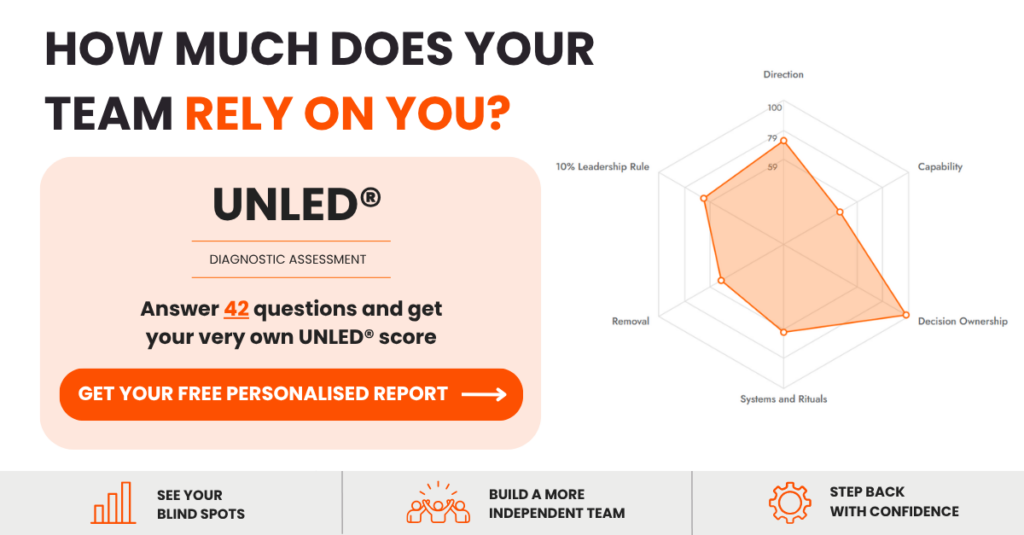
Direction is one of the six parts of the UNLED® model, alongside Capability, Decision Ownership, Systems & Rituals, Removal, and the 10% Leadership Rule. It comes first, because everything after it depends on people knowing where they’re going.
You can coach someone for months, but if they don’t know what they’re being coached towards, you’ve built speed without aim. You can hand over decision rights, and people won’t use them if they’re unsure what a good outcome looks like.
The Difference Between Instruction and Direction
Too many leaders believe they’ve given direction when they’ve only given instruction. They say things like “improve the client experience” or “raise the standard” or “be more proactive.” It sounds good and it feels leadership-like, but it changes nothing, because none of it tells anyone what to do differently tomorrow morning.
Direction only works when it’s usable. Usable direction tells people what outcome matters, what success looks like in practice, and where the boundaries sit, so someone can act on it without checking back every five minutes. That’s the real test. If your team still needs you beside them to interpret what you meant, you haven’t given direction yet.
Years ago I handed a high-value client project to one of the strongest performers in the business. He got the brief, the context and the deadlines, and he delivered everything on time to a technically perfect standard. The client’s reaction was lukewarm. They said it felt flat. When I went back through what I’d given him, the gap was obvious. I’d told him what to produce and never explained what the work meant to that client, why it mattered beyond the deliverables, or what it needed to feel like when it landed. He executed exactly what I asked for. I’d asked for the wrong thing.
The Three Layers of Direction
Direction has three layers to it: vision, priorities and standards. Most leaders cover one, some cover two, and very few cover all three. If even one is fuzzy, your team will either hesitate or head off confidently in the wrong direction.
Vision
Vision is where you’re going and why. It isn’t a strategy deck or a poster in reception. It’s what keeps people pointing the right way when the situation gets messy and nobody can ask you.
When it’s missing, people are busy but can’t describe the real end result, and everyone does their best work in a slightly different direction. Ask three team members what success looks like this quarter. Three different answers means you’ve found your gap.
Priorities
Priorities are what matters most right now. When they’re missing, everything gets labelled important, and when everything matters, nothing leads. People then choose based on comfort or noise, because nothing else is guiding them.
Your team also needs to hear what you’re saying no to, or not yet to, which is the part most leaders skip. Telling people what can wait is as useful as telling them what can’t, because that’s the information they need at four o’clock on a Thursday when two things are due and only one can happen.
Standards
Standards are how you expect things to be done. Tone, quality, consistency, all the invisible rules that shape what finished means. When they’re missing, you’re carrying a picture of good in your head that nobody else can see. Work comes back, gets reworked, and everyone learns that the safest move is to check with you first.
This is where dependency is born, out of uncertainty rather than weakness.
How to Spot Which Layer Is Missing
The three layers fail in different ways, and the symptom tells you where to look.
If people are working hard but pulling in different directions, that’s a vision gap. If work starts, stops and shifts constantly, that’s a priorities gap. If you’re forever fixing, tweaking and rewording what comes back to you, that’s a standards gap.
The useful part is that these are visible without anyone having to admit anything. You can spot all three from what lands in your inbox this week.
Making Direction Usable
Direction sticks through rhythm rather than announcement. Leaders often set the goal once in a big meeting and assume it’s landed, then wonder why nobody’s acting on it six weeks later. These three moves keep it live in the day-to-day language of the team.
Move from Task Language to Outcome Language
One shift that works immediately is how you frame the ask.
Instead of “complete the report,” try “produce a report that allows the client to decide X without needing further data from us.” Instead of “call the client,” try “speak with the client and leave them clear on next steps and commit to a date.”
Small change in wording, big change in ownership. Tasks create activity. Outcomes create thinking. The second version also tells someone how to handle the twenty small judgement calls you’d never have thought to brief them on.
The Echo Test
After you’ve set direction, ask the person to play it back in their own words. Frame it as calibration on your side rather than a test of theirs. Something like, “Just so I know I’ve been clear, how are you seeing the goal here?”
What comes back tells you instantly whether your direction landed. You’ll be surprised how often good people misinterpret reasonable instructions. They were listening. Leaders simply overestimate how clear they were.
Asking “any questions?” won’t catch it, because that never gets an honest answer. Nobody wants to be the person who doesn’t follow, so you get a room of nods and a week of guesswork.
Define What Good Looks Like
Pick one recurring deliverable and write down what has to be true for it to count as good. Not perfect. Good. Keep it to a page, share it, and refine it when it turns out to be missing something.
The point is to make the standard visible before the work starts rather than enforcing it afterwards. Questions drop and consistency rises, and you stop being the only person who can tell whether something is finished.
The Question Worth Sitting With
Direction works as a release mechanism. The clearer you are, the less you’re needed in the middle, which is the paradox most leaders never quite believe until they’ve tried it.
Could your team describe the outcome, the priority and the standard without you in the room?
If the honest answer is no, that’s your next leadership move.