Most leaders aren’t short of time. They’re short of focus.
Calendars full, inbox full, days full, and leadership impact spread thinly across dozens of low-value actions. Active all day, influential in moments.
The question behind the 10% Rule is simple and slightly uncomfortable. If you could only spend a tenth of your time actually leading, what would you do with it? Not manage. Not respond. Not attend. Lead.
Most leaders panic at that question, which is exactly the point. Panic forces priority and separates habit from impact.
Where the 10% Rule Sits
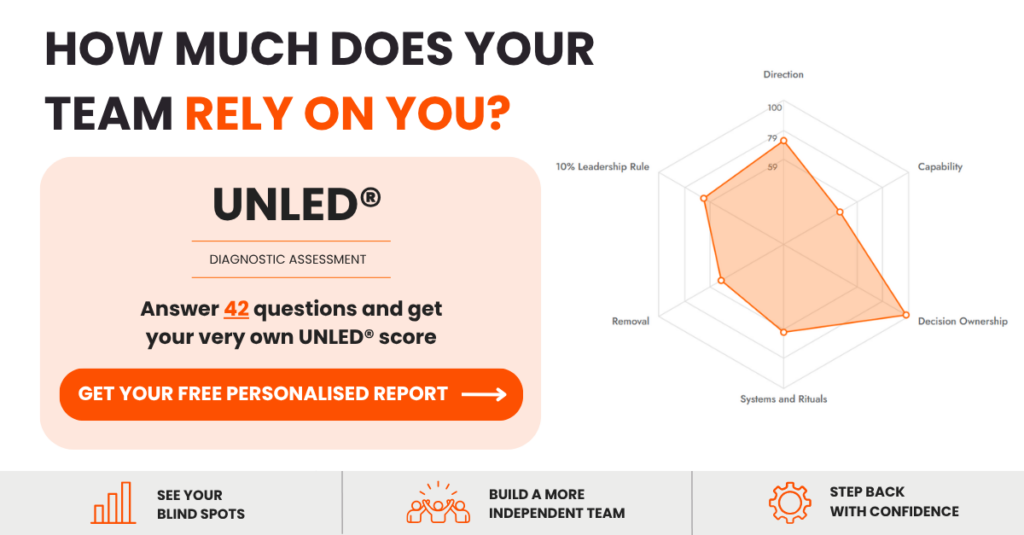
The UNLED® model has four pillars: Direction, Capability, Decision Ownership, and Systems & Rituals. All four hold up Removal, the point where your team performs whether you’re there or not.
The 10% Rule sits underneath the lot of it. It’s the foundation, because none of those pillars get built in the gaps between other people’s demands. They get built in time you’ve deliberately protected for the purpose. Every one of them is leadership work, and leadership work is the first thing a busy week eats.
What Survives the Cut
Strip leadership down to its highest-value moves and very little makes it through. Firefighting doesn’t. Status meetings don’t. Endless approvals don’t. Instant answers definitely don’t.
What survives are the actions that grow people, create clarity, remove friction and build independence.
I learned this early in my career when I was handed a struggling team and told to turn performance around quickly. Morale was low and results were worse. My first instinct was what most leaders reach for: more meetings, more reporting, more oversight. It would have created compliance rather than commitment, and it would have kept everyone leaning on me.
So I narrowed it down instead. Three things only. Rebuild trust, put proper structure around expectations, and coach the team leads so they could make better decisions without me. I ignored almost everything else. Performance turned within months, and the energy shifted long before the numbers did.
Leadership impact is leverage driven rather than volume driven. That was the lesson, and I’ve never seen it work any other way.
The Two Buckets
A practical way is to split what fills your week into two categories, then look honestly at the ratio.
Reactive work
Answering repeat questions. Attending meetings without decisions. Fixing work someone else could fix. Chasing updates. Being the approval layer for everything.
Necessary at times. Dangerous as a pattern. Reactive work keeps today moving and does nothing at all for next quarter.
Leadership work
Coaching conversations. Setting and resetting direction. Timely, specific feedback. Building decision guardrails. Designing systems. Removing blockers your team can’t shift on their own.
Less urgent, considerably more powerful. Leadership work makes tomorrow easier, which is precisely why it keeps losing to whatever is on fire this afternoon.
Most leaders overinvest in the first bucket and underinvest in the second, usually without noticing. The 10% Rule forces the rebalance.
How to Protect It
Deciding that your leadership time matters won’t survive contact with a Tuesday. These three moves are what actually holds the line.
Give the Week One Sentence
Before the week starts, write a single sentence defining your 10% focus.
Something like: coach Hannah through the proposal process so she owns it next time. Or: remove myself from the project approval flow. Or: get delivery standards clear so we stop reworking everything.
One sentence, one focus. It becomes your anchor for the week, and anything that doesn’t support it probably isn’t 10% work.
Block It Like a Client Meeting
Leadership time doesn’t appear on its own, and an open calendar is an invitation. Block it, name it, and treat it as unmovable.
Either small daily blocks or one or two longer sessions. During that time, high-leverage actions only. Coaching, feedback, direction resets, system fixes. No inbox, no admin, no drift.
Leaders who say they’ll fit leadership in rarely do. Leaders who schedule it usually manage it.
Use the Lens in the Moment
The other half of this happens in ten-second decisions rather than blocked-out hours.
When someone brings you a problem, pause and ask yourself silently whether answering it builds dependency or builds capability. Your response changes depending on the answer, and it costs nothing to ask.
Sometimes the fastest help is the weakest leadership.
Where Your Time Is Actually Going
Before you can focus your leadership, you need to see the week you’re really having rather than the one you’d describe.
Go back over the last seven days. How much of it was answering the same questions from the same people, approving things that didn’t need you, sitting in meetings you couldn’t justify, or rewriting work you should have been reviewing? Then look at what’s missing. When did you last run a proper coaching conversation, show someone what great actually looks like, or hand over a decision with clear guardrails?
Most leaders find the second list has enormous gaps in it, and that the reactive list is mostly habit rather than necessity.
Don’t overhaul everything. Make one visible swap this week. Block thirty minutes for a coaching conversation. Replace a repeating approval with a checklist. Turn a status meeting into a written update. Ask “what do you think?” before offering your view.
Leading Better Beats Leading More
There’s a benefit here that gets overlooked, which is energy. Leaders burn out from low-value workload as much as from volume. Doing many small things that change little is more draining than doing a few things that compound.
You’ll know your 10% is working when the patterns shift. Fewer repeat questions. Better first-time decisions. Cleaner delegation. You feel less central and more strategic. If nothing changes, your 10% is probably still mixed in with the noise.
One warning worth stating plainly. This is a discipline to engage where it counts rather than an excuse to disengage. You aren’t leading less. You’re leading where it matters.
Busy leaders feel important. Focused leaders are useful.