Most team slowdowns have nothing to do with effort or skill. They’re caused by hesitation over who owns the call.
People wait. They check. They circle back. They escalate something they could have handled, because escalating is free and being wrong isn’t. When decision ownership is unclear, progress crawls.
Where Decision Ownership Sits
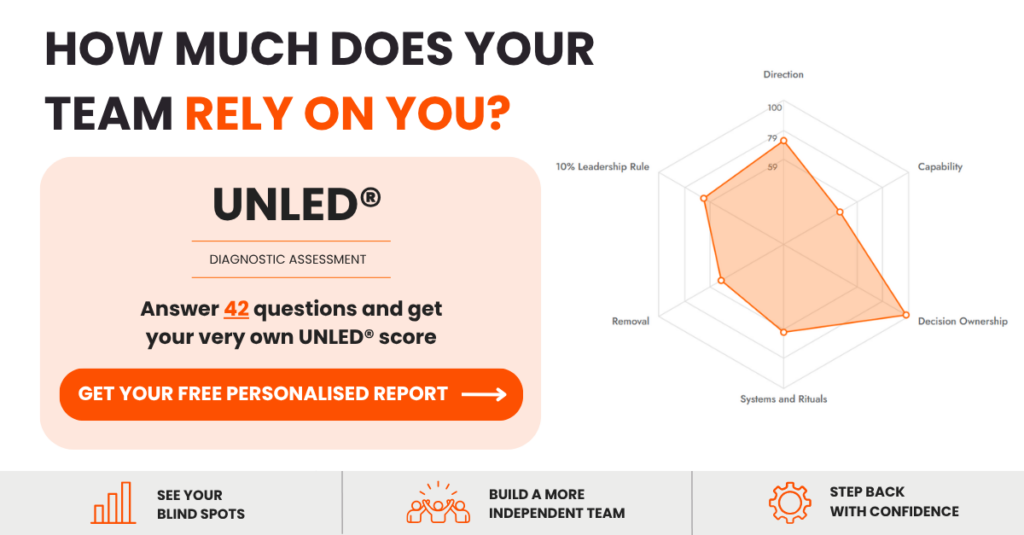
Decision Ownership is one of the four pillars in the UNLED® model, alongside Direction, Capability, and Systems & Rituals. All four hold up Removal, the point where your team keeps performing whether you’re there or not.
It’s the pillar that turns the first two into something real. Your team can know exactly where they’re going and be perfectly able to get there, and still stop and check with you, because knowing how isn’t the same as being allowed to decide. Without clear decision rights, dependency walks back in through the side door.
Decisions are where risk lives. And when risk lives somewhere, people look upward.
You’ve Delegated Tasks, Not Decisions
Most leaders think they’ve handed over decisions when they’ve handed over work. The task moves down and the judgement stays up. That’s a hidden bottleneck, and it’s usually invisible until you’re away for a week.
It shows up in phrases that sound responsible. “I’ll draft it, you approve it.” “I’ll run it past you.” “Just want to check before I send.” Nobody would flag any of those in a one to one. At scale they’re paralysing.
Decision ownership means being explicit about who decides what, and within which limits, without needing sign-off every time. Clear authority rather than vague empowerment.
The other reason decisions come back to you is that you may have trained them to bring them, without ever meaning to. If calls regularly get reviewed, corrected or quietly overturned after the fact, people learn that checking first is safer than deciding. You can tell your team to show more initiative as often as you like. They’re watching what happens to the person who did.
The Three Ownership Levels
Not every decision carries the same weight, so the fix isn’t to hand everything over at once. It’s to sort decisions into three levels, each one telling your team how much involvement you need before they act. Do this with your team rather than on your own, so everyone can see where the lines fall.
Without Me
Decisions your team makes entirely on their own. Routine, close to the day-to-day work, low risk, and straightforward to reverse if they don’t land. Make the call and crack on. No check-in beforehand, no report afterwards.
Heads Up
The decision still belongs to them, but you want to know what they decided and why. They act first and tell you after. Client responses within agreed boundaries, adjustments to a project, scheduling changes, process improvements.
The point here is visibility rather than permission. They aren’t asking you. They’re informing you.
With Me
Decisions where you need to be in the conversation before anything happens. Financial commitments, strategic direction, significant client risk, anything that can’t be undone easily.
This is where most teams go wrong. Far too much ends up in this category, and once it does, you become the decision-making system. The whole point is to keep moving decisions down as capability grows.
Making It Work in Practice
Setting the levels is the easy part. Holding them when someone makes a call you wouldn’t have made is where most leaders quietly take the authority back. These three moves make the levels stick.
Define the Guardrails, Not Just the Freedom
“Use your judgement” sounds generous and helps nobody. Judgement needs rails to run on: budget limits, risk thresholds, brand standards, the handful of things that are genuinely non-negotiable.
Guardrails remove fear without removing accountability. People move faster when they know where the edge is, because they stop spending energy working out whether they’re about to cross it.
Switch from Permission First to Inform After
One language change does most of the work here. Instead of “ask me before,” try “decide, then brief me.”
That switch increases ownership almost immediately. It also shows you where capability still needs building, which is useful information rather than bad news.
Write It Down and Keep It Visible
Don’t carry decision rights around in your head. A simple map of who decides what, who needs consulting and who needs informing beats any amount of verbal reminding, because people can check it without having to ask you.
Keep it usable rather than thorough. A page that gets looked at is worth more than a document that gets filed.
Expect Some Wobble
When you first push decisions down, not every call will match the one you’d have made. That’s the point. If the outcome is sound and the risk is acceptable, resist the urge to pull control back, because overriding people teaches hesitation faster than any amount of encouragement can undo.
Watch for fake consultation too. Asking for input and then always making the call yourself gets noticed quickly. Contribution drops, and real ownership never forms.
If you want better decisions from your team, you have to let them make more decisions. There’s no version of this where the practice is optional.
How You’ll Know It’s Working
The questions change. You hear fewer “can I” and more “I’ve decided.” Approvals turn into updates. Work keeps moving while you’re in a meeting, on a call, or on holiday.
Your own load drops too, and more than you’d expect. You stop carrying every fork in every road, and the decisions that reach you are the ones that genuinely need your level.
If your days are full of small approvals and small clarifications, this is your biggest unlock.